On the record
What was demonstrated under test
Every item below was observed and scored by the independent test organization. Nothing on this page is a projection.
Loaded autonomous transit
Observed carrying a 1,700 lb load autonomously and repeatedly over 1,000 ft at 1 m/s, with no personnel in or beside the vehicle.
GPS waypoint following
Plotted a route and repeated it autonomously multiple times at 0.7, 1.1 and 1.5 m/s, following a series of GPS waypoints.
Mode transition
Transitioned seamlessly between remote-controlled and autonomous modes in both directions, scored independently.
Mixed terrain
Repeatedly and autonomously traversed sand, clay and gravel plus a 30-degree horizontal slope, holding a prescribed GPS route at 1 m/s across all of them.
Sustained patrol
Ran a 0.5 mi perimeter loop continuously and autonomously for 30 minutes at 1 m/s without degradation of the planned route.
Remote operation at range
Operated under direct remote control at over 1,000 ft from the operator, after the receiving antenna was changed mid-test.
Footage
Recorded operation
GPS waypoint following
Driverless route execution on the soil lanes, and traverse of the 30-degree slope.
Loaded outdoor handling
Lifting and moving a containerized load across unimproved ground.
Autonomy as an applique
Fitted to a platform already in service
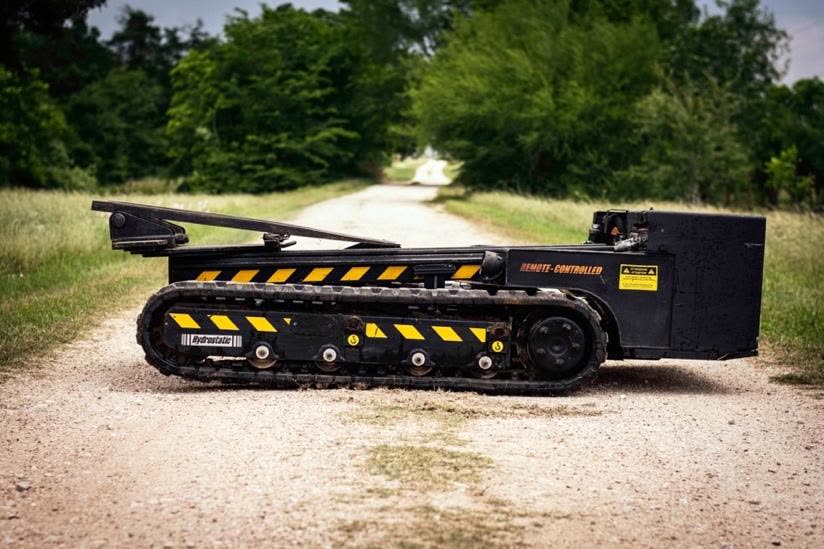
The autonomy is a kit, not a new vehicle. An MPEP is disconnected from its remote-control compute unit and connected to the autonomy unit and sensor set — embedded GPU compute, LiDAR, visual and thermal cameras, and GPS/IMU — feeding a touchscreen operator display that carries active task, speed, trajectory, and vehicle and sensor health.
The stack is ROS/ROS 2-based and MOSA-aligned, with open APIs and no proprietary data lock. The same framework has been run on a diesel tracked forklift and an electric pallet jack.
- Host platform delivered to Marine Corps organizations and to three Texas Air National Guard wings
- Autonomy developed at the Texas A&M Center for Autonomous Vehicles and Sensor Systems under an Air Force SBIR, led by L5VEL founder Dr. Srikanth Saripalli, with host-platform partner Tracks North America
- Carried forward by L5VEL with the same team and code baseline
Host platform
Specifications
Dimensions and ratings for the platform the autonomy kit is fitted to.
| Rated lift | 3,968 lb (1,800 kg) |
|---|---|
| Gross weight | 4,519 lb (2,050 kg) |
| Length, mast retracted | 93.3 in (2,370 mm) |
| Width | 55.9 in (1,420 mm) |
| Minimum height | 30.7 in (780 mm) |
| Engine | Kubota V1505 diesel, 24.8 hp (18.5 kW) |
| Fuel capacity | 7.1 gal (27 L) |
| Maximum speed | 8 km/h |
| Rated grade | 60° |
| Payload interface | Universal skid-steer plate |
| Drive | Tracked |
Supplier ratings for the host platform, not L5VEL test results. The autonomous figures on this page are the independently measured ones.